



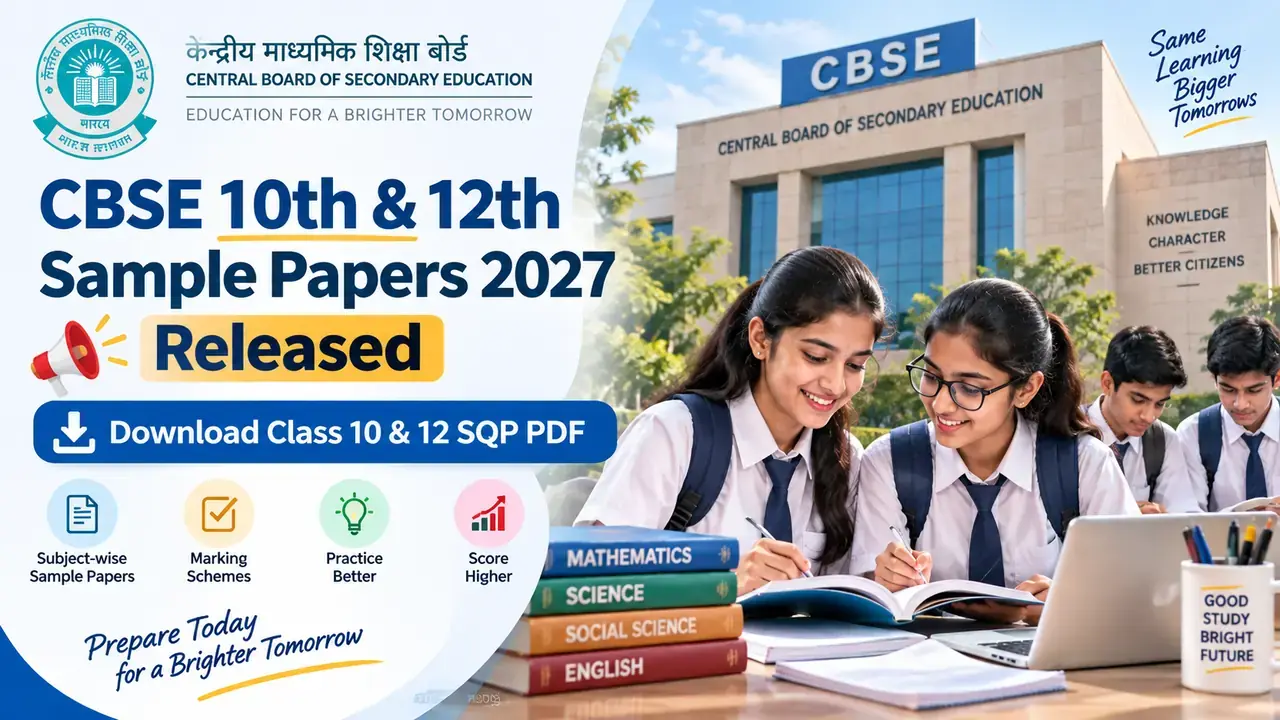
CBSE Board Exam 2027: Sample Question Papers Released for Class 10 & 12 — Complete Exam Guide & Preparation Strategy
For millions of students preparing for the Class 10 and Class 12 board examinations, board results are far more than high school grades. They form the foundational benchmark for college admissions, competitive entrance exams such as JEE, NEET, and CUET, scholarship applications, and future career credentials. With the Central Board of Secondary Education (CBSE) officially releasing the CBSE Sample Papers 2027 along with authoritative Marking Schemes, students now possess the exact official roadmap to achieve academic distinction.
In accordance with the National Education Policy (NEP 2020), the 2027 board exams implement a decisive shift toward competency-driven assessment. Pure memorisation has been replaced with higher-order evaluation, situational case studies, and critical thinking questions that represent at least 50% of the aggregate theory paper. To help students across India prepare strategically, verified bundles of CBSE 2027 sample papers PDF download and subject-wise chapter tests are freely available on TargetExams.
Overview of the CBSE 2027 Board Examination Architecture
The 2027 examination framework introduces standardized structural consistency across all core academic disciplines in secondary and senior secondary divisions:
| Evaluation Component | Weightage Ratio | Assessment Format | Career & Academic Skill Built |
|---|---|---|---|
| Competency-Based Assessment | 50% Minimum | Case Studies (Section E), Source Interpretations, Assertion-Reasoning | Real-world application, analytical deduction, and problem solving. |
| Objective / Select Response | 20% | Multiple Choice Questions, Terminology Identification | Conceptual precision, speed, and eliminating distractors under time constraints. |
| Constructed Subjective Response | 30% | Short Answers (2M/3M) and Long Analytical Derivations (5M) | Written articulation, structured arguments, and logical presentation. |
This balanced structure ensures that candidates master foundational concepts while cultivating the analytical reasoning skills essential for higher education and competitive professional examinations.
Why Board Exam Preparation Demands Professional Strategy
Securing a top percentile in the CBSE 2027 examinations is not an accident of natural talent—it is the direct outcome of disciplined, structured preparation. Candidates who excel adopt three strategic study principles:
1. Mastering the Examiner's Marking Scheme
In CBSE evaluation, answers are graded using step-by-step positive rubrics. In numerical and mathematical problems, full marks are awarded for stating formulas, substituting variables with standard SI units, and showing clear intermediate calculations. In humanities and commerce, evaluators look for specific NCERT value points. Studying the official Marking Scheme teaches students how to structure answers to capture every available mark.
2. Conquering the 15-Minute Reading Period
Between 10:15 AM and 10:30 AM, CBSE grants a mandatory 15-minute question paper reading window. Top performers use this interval to scan internal choices in Section D and Section E, locking in their decisions before writing commences. This eliminates indecision and ensures immediate momentum when the writing clock begins.
3. Simulating Full 3-Hour Exam Conditions
Practicing questions in an unhurried, comfortable environment fails to build the cognitive stamina required for a 3-hour examination. Sitting for full-length timed simulations trains speed, reduces examination anxiety, and ensures adequate time for final answer verification.
90-Day Master Study Timetable for Class 10 & 12 Aspirants
Follow this phased, practical 90-day timetable to ensure complete syllabus mastery prior to your board examinations:
Phase 1 (Days 1 to 30): Thorough NCERT Consolidation
Complete back-of-chapter exercises and exemplar problems across all core subjects. Create one-page formula and theorem summary sheets for daily morning review.
Phase 2 (Days 31 to 60): Competency & Sectional Practice
Dedicate time daily to solving 15 to 20 competency questions from Section A (Assertion-Reason) and Section E (Case Studies). Audit mistakes against the official marking scheme.
Phase 3 (Days 61 to 90): Full-Length Timed Simulations
Solve 5 to 8 complete sample papers per subject strictly from 10:15 AM to 1:30 PM. Focus on neat presentation, clear margins, and finishing 15 minutes early for thorough review.
Strategic Importance of Board Marks for Higher Education & Career Growth
While entrance tests like CUET, JEE, and NEET govern specific university admissions, board examination marks play a critical role in multiple higher education pathways. Top private universities, engineering institutes, and foreign colleges enforce strict board percentage thresholds (often 75% or 80%) for eligibility and merit scholarship consideration. Furthermore, prestigious corporate recruitment drives, government public service commissions, and defense academies continue to evaluate high school transcripts as indicators of sustained diligence and academic consistency.
Many competitive government recruitment drives—including state civil services, banking probationary exams, and public sector enterprise assessments—require verified minimum aggregate percentages in Class 10 and 12 for candidate shortlisting. A high board percentage remains an invaluable lifelong credential on every professional curriculum vitae.
National Scholarship Schemes Linked to Board Performance
Exceptional academic performance in the CBSE board examinations unlocks significant financial grants and fellowship programs across India. The Ministry of Education's Central Sector Scheme of Scholarship for College and University Students awards annual stipends to top-percentile board examinees whose family income falls within designated limits. Similarly, the Kishore Vaigyanik Protsahan Yojana (KVPY) legacy avenues, INSPIRE fellowships, and various state government merit incentives prioritize students with distinguished board marks, providing substantial fee waivers throughout undergraduate study.
Building a Resilient Daily Study Routine: The 50-10 Pomodoro Method
High cognitive performance requires strategic breaks to prevent mental exhaustion. Top educators recommend structuring your daily board preparation using the 50-10 Pomodoro cadence: 50 minutes of intense, single-task immersion followed by 10 minutes of complete cognitive rest without digital screens. Use your 50-minute study blocks to tackle challenging numerical derivations or analytical case studies, and use your rest breaks to stretch and hydrate. This rhythmic study protocol maintains sharp concentration across marathon 6-hour daily study schedules.
Additionally, dedicate the final 30 minutes of every study day to writing down three concrete academic goals for the following morning. Knowing exactly which chapter or sample paper section you will tackle when you sit at your desk eliminates morning procrastination and creates immediate study momentum.
Mental Health, Sleep Hygiene & Peak Performance Architecture
Aspirants frequently fall into the trap of burning the candle at both ends, studying late into the night while sacrificing sleep and nutrition. Extensive cognitive research demonstrates that sleep deprivation degrades executive functioning, causing severe recall lapses during stressful examinations. Maintain a fixed sleep window of 7 to 8 hours daily. Incorporate 30 minutes of light aerobic exercise or brisk walking in the late afternoon to dissipate cortisol and recharge mental stamina.
Bridging Board Exam Concepts to Competitive Entrance Tests (JEE, NEET & CUET)
One of the most persistent anxieties among Class 12 students is managing the perceived friction between subjective board exam preparation and objective competitive entrance examinations such as JEE Main, NEET UG, and CUET. In reality, the 2027 curriculum alignment demonstrates that these goals are complementary rather than conflicting.
The core theory evaluated in competitive entrance examinations is 100% drawn from the NCERT syllabus. When you practice writing detailed step-by-step derivations in Physics or balancing chemical reaction mechanisms in Chemistry for your board examinations, you are building the deep conceptual foundation required to solve complex, multi-layered multiple-choice problems in entrance exams. The only distinction lies in execution speed and answer format. By pairing your daily board exam sample paper practice with timed objective problem sets on TargetExams, you develop the versatility to articulate answers in board booklets while rapidly eliminating distractors in competitive tests.
Bridging Board Exam Concepts to Competitive Entrance Tests (JEE, NEET & CUET)
One of the most persistent anxieties among Class 12 students is managing the perceived friction between subjective board exam preparation and objective competitive entrance examinations such as JEE Main, NEET UG, and CUET. In reality, the 2027 curriculum alignment demonstrates that these goals are complementary rather than conflicting.
The core theory evaluated in competitive entrance examinations is 100% drawn from the NCERT syllabus. When you practice writing detailed step-by-step derivations in Physics or balancing chemical reaction mechanisms in Chemistry for your board examinations, you are building the deep conceptual foundation required to solve complex, multi-layered multiple-choice problems in entrance exams. The only distinction lies in execution speed and answer format. By pairing your daily board exam sample paper practice with timed objective problem sets on TargetExams, you develop the versatility to articulate answers in board booklets while rapidly eliminating distractors in competitive tests.
Long-Term Career Value of Comprehensive Board Preparation
Beyond competitive exam scores, the disciplined work habits cultivated during intensive board examination preparation establish lifelong professional skills. The capacity to budget 180 minutes under high scrutiny, synthesize complex technical information into structured bullet points, and maintain calm emotional composure under pressure directly translates into professional success across software engineering, corporate finance, civil services, and entrepreneurial ventures. Treat your 2027 board exam preparation as an investment in personal resilience that will benefit your career for decades to come.
For further subject-level analysis and exam strategy, check out our related guide on CBSE sample papers vs previous year papers guide.
Frequently Asked Questions on CBSE Board Exams
How does a strong CBSE Class 10/12 score help in future career pursuits?
High CBSE scores provide a solid conceptual foundation for competitive entrance exams like JEE, NEET, and CUET, fulfill eligibility criteria for elite university admissions, and establish academic merit on early career resumes.
Are internal assessment marks added to the theory paper marks?
Yes. For Class 10, passing requires 33% combined across internal assessments (20 marks) and the theory board exam (80 marks). In Class 12, students must secure 33% separately in theory and 33% separately in practicals/internals.
Where can students access free chapter-wise mock tests and sample papers?
TargetExams provides 100% free chapter-wise online mock tests, verified previous year question papers, and official CBSE sample papers with marking schemes.
Your board exams are a vital stepping stone toward academic and professional success. Ground your preparation in the official 2027 sample papers, execute your study plan with consistency, and achieve the outstanding board results your dedication deserves.


Comments (0)
No comments yet.
Leave A Comment